
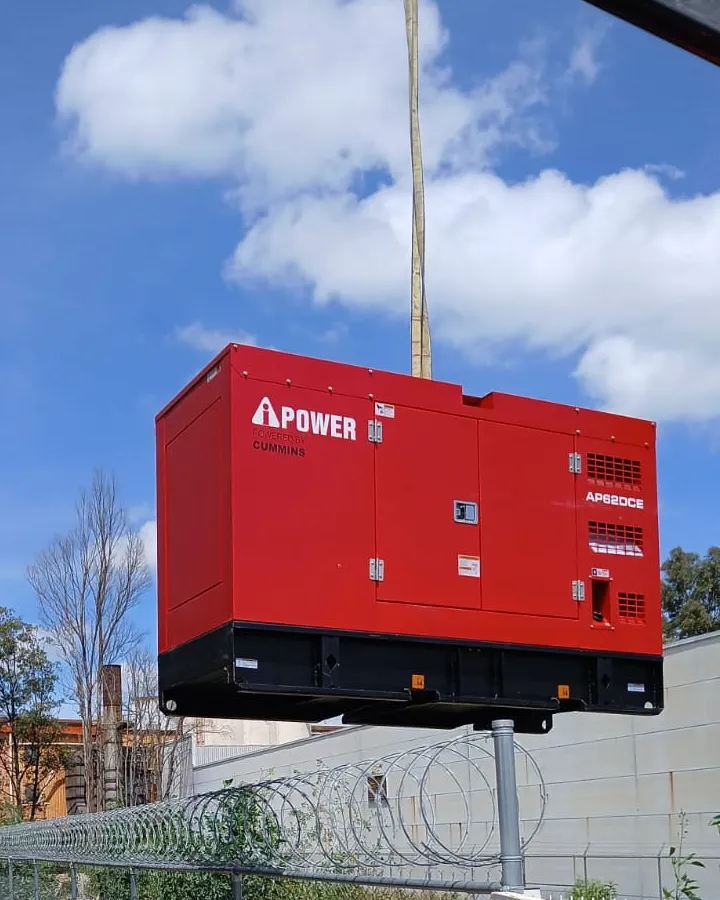
Diesel generator in Mexico
A diesel generator in Mexico, sized on your real load
Most badly bought generators fail for the same reason: they were picked from a price list, not from what the plant cannot afford to lose. We sell and rent diesel and natural gas generators, work out the size from your actual load, and take the project from sizing to start-up. Anywhere in Mexico.
Sale and rentalDiesel, 22 to 1,600 kWNatural gas, 20 to 1,500 kW
What an outage really costs
The problem is not the dark, it is what stops
When the grid drops, the expensive part is almost never the light. It is the production line that halts mid-batch, the cold room that starts to warm up, the elevator with people inside, the server that shuts down without saving and the whole shift that cannot work while someone looks for the electrician's number.
Product and process
Some processes cannot be paused halfway. A batch in progress, a cold chain or a furnace that cools down costs you material, not just time.
Idle people
The cost of a shift runs whether they work or not. In a plant with 40 people, two hours without power is eighty hours of payroll you already paid.
Safety and compliance
Emergency exits, fire pumps, elevators and medical equipment are not optional. In several industries backup power is a requirement, not an upgrade.
So the right question is not "how much does a generator cost" but "what does each hour without power cost me". With that number, the equipment picks itself.
Why diesel
Why industrial plants choose a diesel generator
Diesel is still the standard in heavy industry, and not out of habit. Four concrete things keep it there, and none of them is the price.
- 01It depends on nobody
The fuel is in your own tank. You do not need the gas network to stay up, which is exactly what can fail in an earthquake or a contingency.
- 02It carries a high load
It responds well when large motors come on all at once. Where starts are heavy is where the difference shows most.
- 03Long autonomy
With the right tank it holds a full shift. If you need to keep going longer, you refill it without stopping the unit.
- 04It starts from cold
Built for heavy duty and for starting on the first try after weeks idle, which is how an emergency generator lives.
What is inside
Industrial generators: four components set the price
Two industrial generators of the same size can cost very different amounts, and the gap is almost never in the kilowatts. Learn these four parts and you can compare any two quotes without being an electrical engineer.
- 01The engine
It is the heart and most of the cost. Make sure it is rated for continuous duty, not occasional use, and that parts and service are available in Mexico.
- 02The alternator
It turns motion into electricity. Look for automatic voltage regulation (AVR), which keeps the voltage steady when the load changes, IP23 protection against dust and moisture, and class H insulation for high temperatures.
- 03The control panel
It is the brain. It shows the operating parameters and protects the equipment. There are basic panels and panels with remote monitoring.
- 04The chassis and canopy
They set the noise level, the resistance to weather, the built-in tank and how the unit is handled on installation day.
Power ratings
How to read the kilowatts on a datasheet
This is where the confusion is greatest and where a mistake costs the most. Three concepts that are not the same thing.
What it sustains always
The load the unit can deliver with no limit on hours. This is the number that matters if the generator will run often or for long periods.
What it gives at the peak
A little higher, but only during a grid failure and for a limited number of hours a year. Sizing a continuous-duty application with this number is the classic mistake.
They are not interchangeable
kVA is apparent power and kW is real power. The relation between the two depends on the power factor of your installation, so always compare in the same unit.
If you hold two quotes and one looks much cheaper, check first whether they use the same unit and the same power rating. Often that is the whole difference.
Backup generator sizing
A backup generator is sized on your load, not on your floor area
Most badly bought generators were chosen by price or by what the neighbor had, not by the real load. A small unit shuts down when you need it most; one that is too large is paid for twice, when you buy it and every month in fuel.
- 01What cannot go down
We list the critical circuits with you. It is almost never the whole plant: it is a part, and that part defines the equipment.
- 02How much it draws at start
Motors ask for several times their normal consumption at start. That peak, not the nameplate consumption, is what brings down badly calculated units.
- 03How many hours
Covering twenty-minute outages is not the same as holding a full shift. The tank and the autonomy come from there.
- 04Diesel or gas
It depends on whether you already have a natural gas connection, how many hours a year the unit will run and where it will be placed.
- 05Quote and delivery
We hand you the proposal with the capacity justified, and we coordinate rigging, installation and start-up.
Before the unit goes on site we also check three things: its weight and whether the slab can carry it, the ventilation for the radiator and the exhaust, and the access route on delivery day.
Diesel or natural gas
Two routes, and the choice is not a matter of taste
Both technologies solve the same problem, but not in the same scenario. If you already have a natural gas connection, there is a question worth asking before you buy diesel: why store fuel and schedule refills when the energy already arrives by pipe?
No tank, no refills
Fuel storage, the refill schedule, inventory control and the risk of running short on the very day you need it all go away.
Less noise, cleaner burn
It burns cleaner and runs quieter. That matters on a rooftop, near offices, in a hotel or where neighbors and emission limits apply.
No fuel that degrades
Stored diesel degrades and needs care if the unit runs few hours a year. With piped gas that problem does not exist.
The other side, said plainly: if the gas network goes down, your backup goes down with it. Where full independence is the point, we still recommend diesel. Without a natural gas line, LP gas (liquefied petroleum gas) in a stationary tank allows the same setup, with refills back in the picture.
A natural gas unit also depends on something outside the equipment: your connection. A large generator draws far more gas than a boiler, so we check that the connection delivers the pressure and flow before you have a quote in hand.
Ranges
From a small facility to a full production plant
These are the ranges we work in. The exact step comes out of the load study, and it is rarely the one people assume at the start.
22 to 1,600 kW
20 to 1,500 kW
Turnkey
We are direct distributors of AiPower. Already know which model you need? Check our online catalog and we will quote it for you.
Rent or buy
If the need has an end date, rent
If you know when the need ends, renting almost always comes out better and nobody is left with an idle asset. We say it even when a sale would suit us more.
We rent diesel and natural gas units by the day, the week or the month. We coordinate transport, placement, connection and start-up, and what each rental includes, fuel among it, is spelled out in the proposal. If your need is permanent, buying starts to make sense, and if it repeats every year we run the numbers on how many rentals equal a purchase.
Who we do it for
Where an emergency generator earns its place
Every industry has its own "this can't go down". Recognizing yours is half of the project.
Zummat also works in industrial LED lighting. You can see everything we do from the Zummat home page.
Frequently asked questions
What people ask before requesting a quote
Do you sell or rent generators?
Both, diesel and natural gas. If your need has an end date, such as a construction project, an event or grid maintenance, we will recommend renting even when a sale would pay us more.
Should I choose diesel or natural gas?
If you already have a natural gas connection and the generator will run many hours a year, gas usually comes out ahead on fuel and logistics. If you need full independence, long autonomy or the site has no gas network, diesel is the way. We settle it with your numbers.
What size of generator do I need?
It comes from your real load, not from the size of your building. We list which circuits have to stay alive, check how much current the motors draw at start and define how many hours the unit has to hold. With that we tell you the exact step and why.
What do I need to send to get a quote?
The list of what cannot go down, the equipment you want to run, where the site is and the site conditions: space, firm ground and ventilation. For a rental, add your start and end dates. You do not need to know kilowatts. Call 55 4946 2900 or write to [email protected] (Monday to Friday, 8:00 a.m. to 7:00 p.m.).
Where in Mexico do you work?
Nationwide. Our office is in Toluca, State of Mexico, and we go from there to wherever your operation is.
Is an emergency generator the same as an industrial generator?
In practice the terms are used as synonyms. "Generator" names the equipment and its components, and "emergency generator" names the function, which is to take the load when the grid fails. The same unit can serve as backup or as the main source at a site with no grid.
Tell us what cannot go without power
A short call is enough to tell you where the capacity lands and whether your case is a purchase or a rental.