
Solar street lights in Mexico
Solar street lights and industrial LED lighting in Mexico, designed before you buy
Most lighting is bought by the piece: so many luminaires, so many watts, and hope for the best. What you end up with is a high electric bill, glare in some places and dark corners in others. We do it the other way around. We measure what you use today, design the lighting for your space and show you the result before you buy a single luminaire. Where there is no power line, we put in solar. Then we install it, anywhere in Mexico.
Solar and grid-connectedDialux design at no costInstallation above 5 meters
What bad lighting costs
The electric bill is only the part you can see
An old or poorly planned installation does not fail all at once. It fails a little every day: in what you overpay, in what your people cannot see and in what an inspector can find. Because nobody adds it up, it seems to cost nothing.
Watts that light nothing
An older-technology lamp costs the same whether it lights well or badly. If it also sits in the wrong place, you pay to light the ceiling, an empty aisle or half a parking lot nobody uses.
People who cannot see well
With too little light, with shadows or with glare, a label gets misread, an order gets picked wrong and eyes tire before the shift ends. None of that shows on the bill, but you pay for it.
Safety and the standard
NOM-025, the standard from Mexico's labor ministry (STPS) for lighting at workplaces, sets how much light each area needs. A loading dock, a stairway or a maneuvering yard left half lit is a risk to your people and a finding at the inspection.
The right question is not "how much does a luminaire cost" but "what does the light I have today cost me every month". With that number, the project justifies itself.
Solar street lights
Solar street lights: where the cable does not reach, the sun does
A dark road is rarely a lamp problem. It is a cable problem: on some stretches, running the power line is what stops the project. A solar luminaire does not need one, because it generates by day the energy it uses at night. And where the grid is already there, an LED street luminaire lights the same road using less power.
All of them are built for outdoors and resist water, dust, impacts and corrosion. They come in different power ratings, beam angles and mountings. We choose between solar and grid-connected based on whether there is already a power line on site, how wide the road is, how tall the pole is and how many hours the lights will be on. Already know which model you need? Check our online catalog and we will quote it for you. We distribute Osram, Ledvance, Philco, Tecnoled, Tecnolite, Dimas, Jungo, Mercury, ILV, Veimont, Everlum e Ilux, and we choose the brand by what your project requires.
Where street lighting goes
Roads, parks and everything that stays lit at night
We handle projects for government and for companies. Who owns the lighting changes, the question does not: how much light is needed, and how it stays on every night.
LED high bay lights
LED high bay lights for ceilings over 6 meters
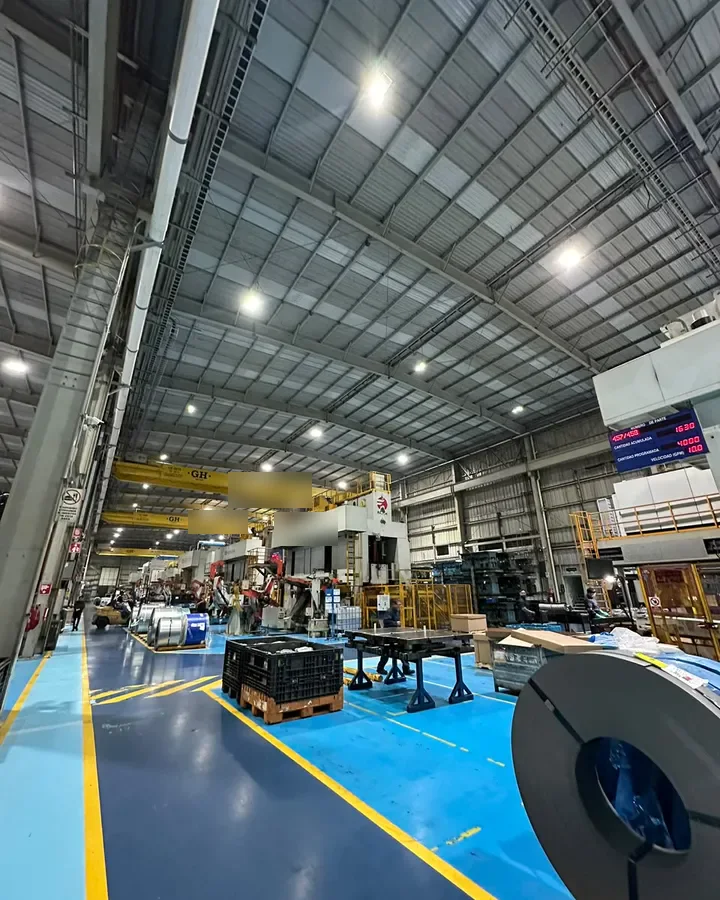
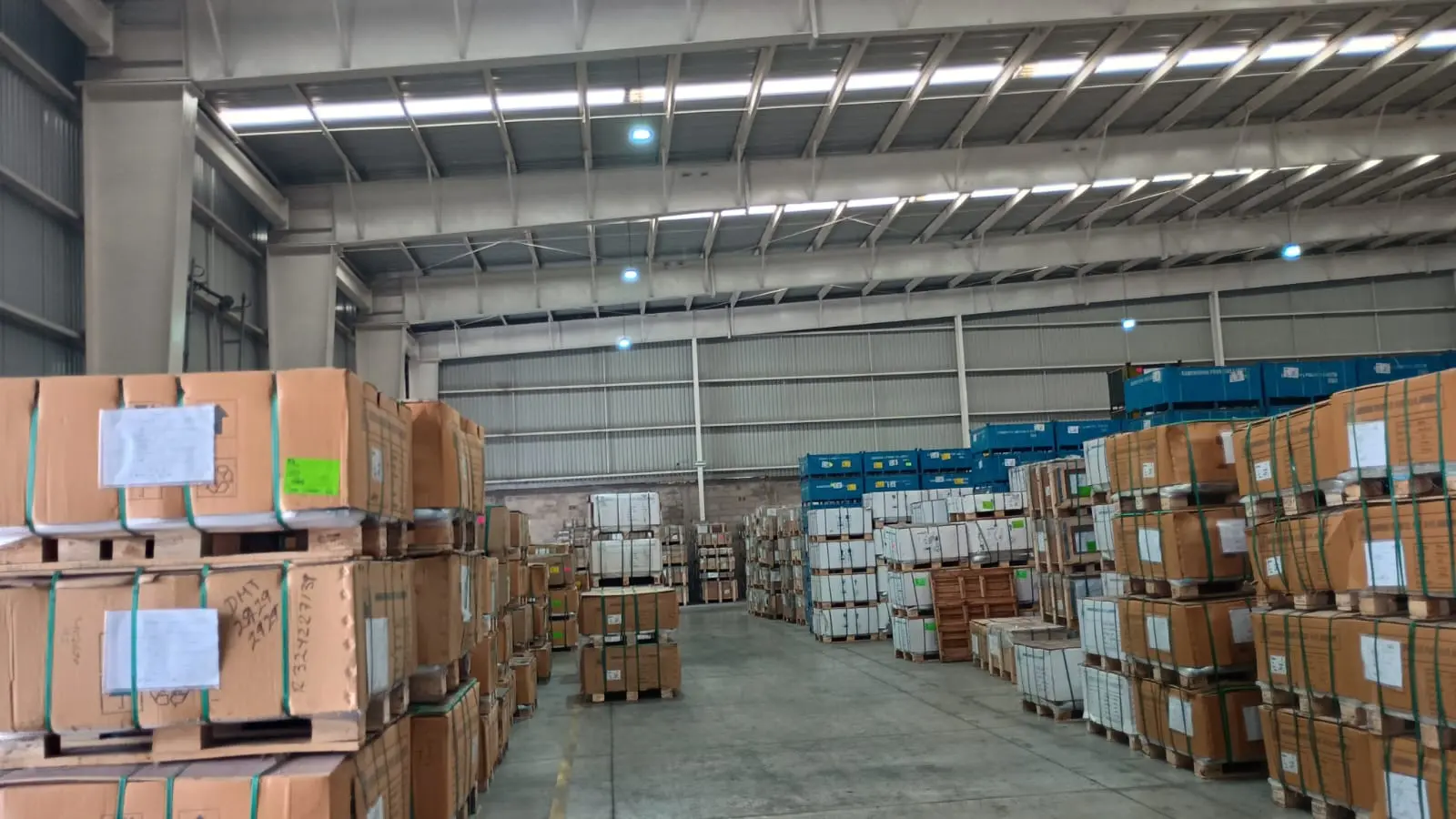
In a tall building every meter counts. A lamp that was not made for that height, or that hangs in the wrong place, burns full power and lights half the space. What matters is not how many watts hang from the ceiling but how much light reaches the aisle, the rack and the work table.
Shadows between the racks
If the luminaires do not follow the layout of the building, the aisles stay dark and the empty areas glare. Orders get picked wrong, labels get misread and forklifts move with less visibility.
Power you do not need
When nobody calculates, people buy extra just in case. That means extra lamps and mounting hardware, and extra power use you pay for every month, with nothing to show for it.
Every replacement is a lift job
Changing a lamp at that height takes equipment, trained staff and shutting down the area below. The longer the luminaire lasts, the fewer times you go through it.
So the right question is not "how many lamps do I hang" but "how much light do I need at floor level in each zone". That is what the design answers.
They go in factories and production plants, warehouses, distribution centers, supermarkets and other large spaces, and at loading docks, inside and outside the building. We have the staff and the equipment to install them above 5 meters.
Industrial LED lighting
Industrial LED lighting, turnkey: your space lit before you buy a lamp
You do not invest blind. Before we quote, we measure, design and show you how it will look. Our specialists do the lighting design in Dialux, the lighting design software, and it costs you nothing.
- 01We measure what you spend
A consumption study of your current lighting, in energy and in money, so we compare LED against your own numbers and not against averages.
- 02We design in Dialux
We calculate how many luminaires, of what power and where, to deliver in each area the light levels NOM-025 requires.
- 03We show it to you
A 3D render of your space already lit, so anything you do not like is fixed on the plan and not on site.
- 04We quote with the payback
The full cost, and how long it takes to recover the investment from what you stop paying for power.
- 05We install it
Our own trained staff, with DC3 certificates (the training credential registered with the STPS) and the equipment to work above 5 meters.
More spaces
Parking lots, gas stations, sports fields and offices
The same turnkey project, applied to spaces that each ask for their own light: the height, the standard, the hours of use and the way to save are different.
Gas stations are the case where we slow down. Hazardous-location equipment (explosion-proof floodlights and high bays) exists in our catalog, but which zones of your station call for it is defined by the station's own project, and we review it with you before proposing any luminaire. In a parking lot at a workplace, we design to the NOM-025 light levels for that area. In an office, savings of 50 to 75% of the lighting spend can be achieved.
What changes with LED
Lighting as an investment, not an expense
These are the figures we publish for our LED lighting projects. We do not assume yours: it comes out of the consumption study, and we hand it to you in writing before you decide.
Up to 75%
Under 3 years
Above 5 meters
Lighting is one of Zummat's two lines. The other is backup power: see our industrial generators, or start from the Zummat home page.
Frequently asked questions
What people ask before requesting a quote
How does a solar street light work, and what is an all-in-one?
The panel generates energy during the day, and the luminaire stores it and uses it to switch on at night. That is why it needs no grid connection and no cabling between poles. An all-in-one, also written "all in one", has the panel, the energy storage and the LED lamp in a single piece on top of the pole. Others have the panel mounted apart from the lamp.
Should I choose solar or grid-connected street lights?
It depends on whether there is already a power line at the site, how much light the road needs and how many hours the lights will be on. We do not decide it from a catalog: we settle it in the design and explain why.
Which LED high bay lights does a warehouse or plant need?
In ceilings over 6 meters we use LED high bay lights, also called bell-type lamps. For loading docks, yards and facades we use industrial floodlights. How many you need comes from the ceiling height, the layout of the racks or lines and the light NOM-025 requires for each task. We calculate it in Dialux and hand you the plan with the exact number, at no cost.
How much can I save by switching to LED?
It depends on what you have today and how many hours the lights are on. When replacing older technology, lighting spend can drop by up to 75%. We have also delivered projects that pay for themselves in under three years, and yours goes in the quote. So you do not get an average: we measure your current consumption first and give you your own number before you buy.
What is NOM-025, and does it matter for my project?
It is the STPS standard that sets the lighting conditions at workplaces: how much light each area needs, depending on the task done there. We design to the light levels it sets for each space, so the installation saves power and also complies. For a gas station, we also review the requirements specific to the station with you.
Can you light a site far from Toluca?
Yes. Our office is in Toluca, but the work follows your site, wherever it is in Mexico: a plant, a parking lot, a gas station, a sports field or a remote access road. Start with a short call about the space and we take it from there.
Tell us what space you want to light
With a short call we can tell you which luminaire fits and what we need to measure your consumption.